In the wire drawing industry, the lifespan of a die directly impacts production efficiency and cost control. A high-quality die, if maintained correctly, can process tens of thousands of tons of wire. Conversely, frequent replacements not only waste money but also lead to significant downtime losses.
This article breaks down the root causes of die failure and provides a practical framework for maximizing your tooling investment.
1. Debunking the Myth: It’s Not Always a “Quality Issue”
When a die wears out prematurely, many operators instinctively blame the manufacturer. However, industry data shows that over 60% of abnormal die wear is caused by mismatched process parameters, not the material quality itself.
Compatibility over Hardness: For instance, using Tungsten Carbide (TC) dies for high-hardness stainless steel without optimizing lubrication will lead to rapid failure.
The “Total Cost” Mindset: Shift your focus from “price per die” to “tooling cost per ton of wire.” Understanding this transition allows you to move from passive replacement to proactive optimization.
2. Four Critical Factors Affecting Die Life
A. Material Selection & Application Matching
There is no “best” material, only the “most suitable” one for your specific application.
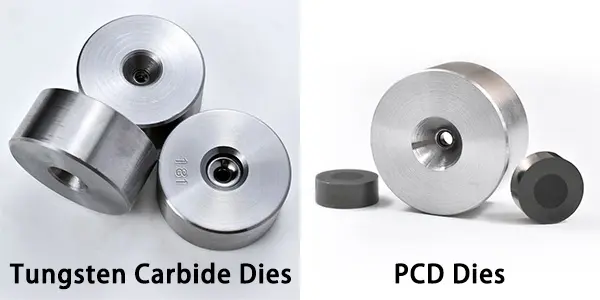
Tungsten Carbide (TC) Dies: Ideal for low-to-medium speed drawing of soft metals (copper, aluminum). They are cost-effective but offer lower wear resistance.
PCD (Polycrystalline Diamond) Dies: The gold standard for high-speed, high-volume production. PCD offers 15–30 times the wear resistance of TC, making it essential for hard wires like stainless steel and high-carbon steel.
B. Die Geometry and Hole Design
The internal profile dictates how wire flows and how stress is distributed.
Approach Angle: If too large, lubricant cannot enter effectively; if too small, friction increases.
Bearing Length: A short bearing causes wire instability and diameter fluctuations, while an excessively long bearing generates heat fatigue.
Reduction Rate Distribution: In multi-stage drawing, overloading a single die stage will cause rapid “ringing” (annular wear).
C. Lubrication System Stability
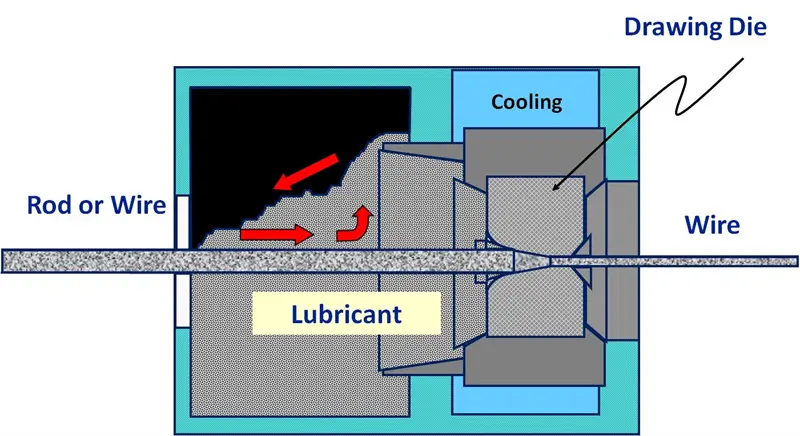
Many dies are “destroyed” by poor lubrication.
The Abrasive Effect: If metal dust/fines from the drawing process are not filtered out, the lubricant turns into a “liquid sandpaper,” eroding the die’s inner walls.
Temperature & Concentration: High temperatures or incorrect concentrations degrade the lubricant film, leading to metal-to-metal contact.
D. Equipment & Operational Precision
Misalignment: If the die is not perfectly centered with the capstan, it creates “one-sided wear,” turning the round hole into an oval.
Sudden Speed Fluctuations: Rapid starts or jerky speed changes create impact loads that can lead to micro-cracking or fracturing.
3. Practical Methods to Extend Die Life
| Strategy |
Key Action |
Expected Benefit |
| Preventative Cleaning |
Use ultrasonic cleaning to remove stubborn metal fines and residual dust. |
Prevents secondary abrasion. |
| Timely Polishing |
Polish the die at the first sign of slight wear rather than waiting for a full “re-cut.” |
Extends total life by 30%+. |
| Optimized Drafting |
Maintain a balanced reduction rate (typically 15–25% per pass). |
Prevents “bottleneck” die failure. |
| Strategic Upgrading |
Replace TC dies with PCD or CVD (Nano Coated) for high-wear stages. |
Can reduce total costs by 50%. |
4. Common Pitfalls to Avoid
-
Ignoring Minor Scratches: Running a die with visible “rings” will amplify the damage and eventually scrap the wire.
-
Dirty Lubricant: Failing to change filters turns your lubricant into an abrasive slurry.
-
Sacrificing Life for Speed: Blindly increasing speed without upgrading cooling or lubrication leads to thermal cracking.
-
Neglecting Inlet Wire Quality: Scale or dirt on the incoming wire acts as a direct abrasive against the die.
5. Conclusion: Longevity is Engineered, Not Just Bought
Wire drawing die life is a result of a holistic system involving the die, lubricant, equipment, and process. Choosing the right material and maintaining it correctly is far more economical than frequent replacements.
Need a Technical Assessment?
If you are not achieving your expected die life, our technical team can help. Provide us with your wire material, diameter, and drawing speed, and we will evaluate your setup for optimization opportunities.
Contact us today to optimize your production efficiency!
Email: [email protected]
WhatsApp: +8618975857001